Saturday, January 24, 2015

California's Grid has overgeneration/curtailment problems too...

Check out this story at Breaking Energy.

in part:
Four times this past spring, the state’s grid operator had to shut off wind and solar power when it exceeded demand. The largest such curtailment was 1,100 megawatts during the morning of April 27, 2014.
Interesting, no?

That story comes from another source eenews.net and it is a pretty good report... down a bit there is this:
The plants that were curtailed likely received all of their contracted payments from the utilities, as contracts generally have a small curtailment provision built in. But as curtailment becomes more likely, contracts could become more flexible in the future, Bloom said.
"I think it means the contracts will allow for increased flexibility for dispatch by the utilities over time," he said. "There's a big change from the old days, when if you produced, they had to take it."
There will be a need to incorporate energy storage into renewables projects, as well. Right now, a solar project without storage would beat out one with storage solely on cost, even though utilities are under a new mandate as of last year to procure 1.3 gigawatts of storage by 2020.
The grid as free battery is on the way out as the importance of "when" grows. I've been wrapped up on Patent issues and missed the "Duck Curve" as a concept. Let's look into that shall we?

here is a "distributed generators fight back" read on the duck curve:

Solar supporters: Open season utilities duck on Ilsr.org:

"The duck is the perfect vehicle for utility complaints because it casts the growth of distributed solar as a major technical problem (an area where most policy makers defer to utilities) rather than an economic one, where utility complaints can be contrasted with their customer’s desires for more local control over their energy use and costs."
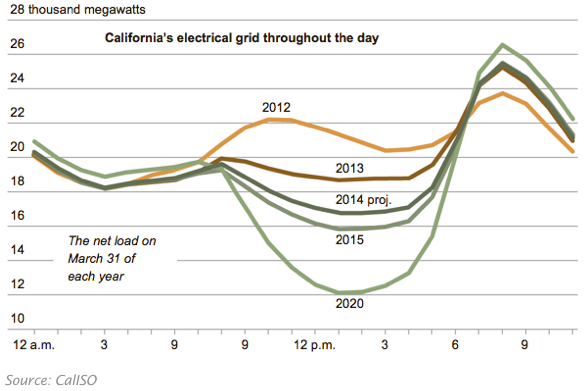
That 5 to 8 ramp is something else! It is certainly a call for west facing PV arrays... And some short-term storage too. What might many solar pre-chilling of HVAC condensers do to that picture? Could a daytime version of the Ice Bear eat the Utilities Duck? The Ice Energy people are used to marketing to utilities (smart) but the other side is also serviceable if you have surplus generation that would be curtailed during the day - better to shunt it to ice and then pull out that service during the peak charge time of 5 to 8...
"Short term storage, meet solar thermal, solar thermal, meet short term storage.

Thursday, January 8, 2015

Breaking news... (wow did this sound familiar)

I got a Google Alert based on my "Solar PVT" find criteria. Usually it just gets me new solar companies that have PVT in their names... but today a jackpot instead.

A beam-splitting photovoltaic thermal receiver for solar concentrators

A photovoltaic thermal receiver that separates incoming light energy by wavelength can produce electricity and thermal output of 150° simultaneously.
 I know! Right? This is what I am talking about. Right down to the 150C heat... The full story.

Then some more digging (god bless the internet - nearly instant satisfaction on things like this)

http://www.sciencedirect.com/science/article/pii/S1876610214003348

Pretty neat stuff. But not a spork-killer I think... only 10 to 20 X concentration and so it has high silicon content and everything they have is at minimum 20 to 40 times as big and materially/coatings intensive as my design... I'm not sure how they see commercial viability. (I hope they do see it as we are all looking for the pay-no-pay line.)

It looks like they might be working with Chromasun. That would be interesting. 

I have to dive into that second paper tomorrow or Saturday as it has the meat... but I thought I'd share as soon as I saw it.

If you read it let me know what you make of it!

Saturday, December 6, 2014

Did we talk about the white Paper in 2011?

It occurs to me that you might not have found the white paper from back in 2011...

It is in a few places. Try this one.

Early on I was trying to figure out if there were any deep flaws I could discover in the high temperature hybrid approach. This paper lays out a defense of the thinking. It is pretty short and some of the data is a good bit less flattering than it could be (caution on my part mostly). Take a look though and let me know what you think. I need to write a new one with the improved optics and reduced cost of goods and maybe some more up to date economic evaluations too.

Not mentioned there but mentioned elsewhere in this blog are my observations about the unrealistic aspect of VC money expectations in a hardware/energy market. This is a really lean domain. Better to strap solar onto a roofing company, or just a lending operation. What winning money there has been in the Solar biz seems to have been there for the people who captured the finance part and some of the tool sellers. There have been winners but not VC style super block busters, or am I missing somebody?

I think about PVTsolar which became First solar and then got bought out by SunEdison, for cheap. At least that is what I gathered. Probably making OK gear and selling it for a reasonable markup etc but not the kind of huge win the VC types that backed the first iteration were looking for. I wonder if those kinds of wins were ever going to be possible in the energy market. I know they need some kind of motivating illusion to take the risk and we are talking about somewhat new markets so optimism is a good thing but while the gear is new the need (energy) is old and it is met by many competitors.

Got to get back to the grind.

Tuesday, November 25, 2014

Focused Sun... a low tech low concentration approach

Ugly - in a good way...

Focused Sun

They must have been in stealth mode as no pictures seem to be on the web save for the ones in the release, until Nov. 17th when they launched an Indigogo campaign. A million dollar goal and no early givers. Yikes. And the csp-world story neglected to mention the indigogo campaign.

https://www.indiegogo.com/projects/focused-sun

It is much smaller than I thought based on the csp-world picture. Pretty good coverage in the video of why it is affordable.  It does not look like it is weather hard to the degree that it should be. But I like the effort to make it low tech and "makeable." I'm in the let many flowers bloom camp: but this does not seem deeply considered.

Also interesting (as a side note) that it is a collaboration between a Swede and some Americans in New Mexico. One of my favorite rivals is also designed by a Swede (the Solarus.se effort). I guess I must elevate my herring intake to stay in the game!

Take a look and let me know what you think.

Tuesday, November 11, 2014

PowerPanel guys are still plugging away. I love the tank design. ALOT.

Check out the video at the bottom of their home page: hot water storage could not be easier I think. Up to 200 F and it can be walked through any doorway and fits 350 gallons. (that's 93 C and 1325 l)

It looks like there are really only two foam parts (wall and half top/bottom) and a liner and an external girdle. Just all kinds of clever. Wish they'd show a price for it.

http://www.powerpanel.com/

My design does not require storage. I just love smart. And this is smart stuff.


Irradiation evenness... getting better by a bunch

Thought I'd tease a bit of the recent findings from the optics team:

Earliest proof of concept:


takeaway... not good but the photons do get there... and I learned a lot.

Knowing where the trouble comes from (and rethinking many other tangentially important elements) gets us this:

these are not the same scale (btw) what we care about is the evenness of the light and of the image. The low value (or more precisely intensity) yellow smear is easily corrected (nearly a column above.) The cell size can now drop to about 1/5 the original intended size. I've not tiled it as a hexagon (an even better fit if you hope to grab circular images with fewer wasted margins. ) Hexagons should fit even better on parent wafers... quick estimate 500 per 156mm pseudo square... that is a tiny bit of Silicon serving a very large aperture.

I am trying to characterize the packing factor (how much margin is lost by the space between cells). Or in my case the space between individual mirror "wells." It is better for the heat (.95 or so) than for the PV but if those smears above get into the center they might scavenge  us up to 92 or so. Which would add aperture-efficiency to our list of accomplishments.

Stay tuned!

Study from the Thermal side of the house...

Thermal Plant .(com) is my new internet crush!

Here are some compelling figures on hybrid PVT systems from a thermal perspective. Optimization of the thermal fraction is their agenda and they pound TRNSYS to get some insight. Cool.

here is some of it:

The performance of the PVT system consists in the renewable energy production, net of auxiliary devices’ consumption. Expressed in terms of primary energy, this balance is in general considered an energy saving for the users. Obtained results are shown in the following figures.

Fig. 7. Total energy saving in case of electric heater and natural gas heater
Fig. 7. Total energy saving in case of electric heater and natural gas heater Fig. 7. Total energy saving in case of electric heater and natural gas heater

 By observing the graphs, it can be seen that primary energy savings are much more consistent in case of electric heater in comparison with natural gas one. Anyway, in both cases, by increasing the PVT collector surface the total energy saving is not increasing linearly, which leads to conclude that global system efficiency is slightly decreasing by increasing PVT area.
This  happens  because  the  largest  number  of  collectors  increases  the  heat  transfer  fluid  mean temperature in each loop, while progressively reducing both the PV and thermal efficiency.
However, to perform a complete assessment of the PVT energy performance, global system costs and
savings potentials must be taken in consideration, as reported hereafter.