Friday, June 23, 2023

 UPDATE (Spring 2023) two important papers came out:

1) https://www.nature.com/articles/s41377-021-00465-1
​I was frankly thrilled when I found a paper this year from Gan Huang, Kai Wang & Christos N. Markides . Christos Markides is head of the Imperial College London’s Clean Energy Lab. 
It is an essential road map for anybody considering  spectral splitting and concentrating approaches. A must read paper. Markides’ inaugural lecture (video link) at ICL also addresses the domain.

The combination of spectrum splitting AND concentration AND PV cell species, taken all together are a pretty complex interactive domain. I had been working using a basic sense of the spectrum available and the response curves for different PV species (mostly Si and GaAs), together with the NREL research cell chart. Which, for my level of design thinking, was sufficient, or so I hoped. But that nature.com article is just the sort of fleshing out that is needed.

2) Here is a super comprehensive survey paper. Markides keeps piling on the good stuff! (with many co-authors) they really cover the hybrid landscape going back decades and up to today. Not just Spectrum Splitters but the whole rogues gallery of hybrid collection. 

Sunday, October 23, 2016

Thanks Mini Maker Faire 2016 at Park Day School

Thanks everyone who came by for my show and tell. It was fun (my voice should be back tomorrow!)

Do hit me up if you had questions or suggestions of who to talk to to help me roll this project forward... More as I know it.

-Paul (paul@paulbostwick.com)

And a white paper (oldie but goodie) at www.solarspork.com

Since it was written, I have found some important loss mechanisms and buttoned them up. I have not had the funds to reanalyze the optic gains and "cash in" those improvements in a new analysis. The main new gain is from the enormous drop in the absorber(emitter) area. It is around .03 of the original area and the reemission is further suppressed by being aimed down into the mirror array rather than out to the cool sky directly. So together they should get our net efficiency of collection at 150C up. But the radiative exchanges are not the sort of things I intuit well - and why intuit when some physics (by smarter people) can do the trick.

The hunt for a suitable cell has hit a jackpot (but I am without funds to buy a small set) in three forms

Alta Devices: Gallium Arsenide thin film cells (I have to de-concentrate for now to use them) I have them in hand.

A small set of silicon concentrators rated for 70 suns (again de-concentrate to use them in prototyping/proof of concept work) that I got from a surplus.

An expensive in small quantities but right on the spec set of silicon "vertical Junction" cells of any size I need/want. I just have to give up $2000 for a minimum order (ugh.)

All of this is compromised by the un-patentability of the device: no monopoly on offer means the returns are compromised for me. I'll work it out, stay tuned!

Wednesday, July 13, 2016

Another hybrid... with huge heatpipes.

http://www.jetsongreen.com/2015/10/hybrid-solar-system-thats-very-efficient.html

here is the press release or whatever passes for one now... I don't see what they could have patented beyond the design. My main concern, looking now, is how material intensive it is. Those heat pipes are huge as they cover the whole exposed aperture. There are some black covers that may or may not be covering heat pipe material but even still the costs should be heroic - it is a copper one.

I'm jammed at work so finding the paper (if one exits) will have to wait. Check the comments - I'll add them there if and when I find it.

Thursday, October 22, 2015

Hawaii is yet again giving us a look at the future

Here are some reports on the meaning and import of Hawaii ending net metering.

Rocky Mountain Institute has a report.

And here is a really good one from an investment blogging site seeking alpha.

Until now, net metering has amounted to protecting distributed generators from wholesale price fluctuations and the normal market price impacts of over-generation mid-day. Time Of Use pricing will follow the duck curve (duck curves actually) and solar will have to find new ways to cut costs and improve economic durability (delivering value in a way more independent of the grid).

The above stories plus my post from awhile back would make a fine primer on the near horizon of solar in early adopting states. California, I'm looking at you...

Friday, October 16, 2015

GE is jumping into empowering the utility user to participate in DR

This is interesting. GE is making a startup/relaunch/rebundle called Current.  They are committing huge resources to it.
(Dumb URL, imho, but whatever.)

I learned about it here.

Grid Edge? Demand Response? Demand Response 2.0? That is part of it, but they are also looking square in the face at energy as a service and that could be a potent, even "game changing" change. But their big company instincts and resources could doom them to sticking with a plan rather than scrap and pivot from one to the next.  Certainly one to watch.


Wednesday, October 7, 2015

Decloaking the High-Temperature Hybrid PVT collector

Long time no blog...

But I come with interesting news (or so I hope) so let's get started:

Back at the start of the High Temperature Hybrid PVT odyssey it was not even high temp, it was just an effort to cool the PV for higher performance in the summer. Then I started digging in to what to do with the heat. From there I moved onto the existing hybrids (discussed elsewhere in this blog).

In the early days, the theory was a mix of:
"This seems possible, but what am I missing?"
and
"Somebody must have already solved this problem..."

However, as time passed, I came to understand the compromises involved in cooling the photovoltaic components. Far more importantly, I've come to see the role of finance in shaping the evolution and distribution of solar systems. Much of this blog has been about that and the comings and goings within the concentrator and hybrid PVT segments of the solar collector industry.

Behind the scenes (the main subject of this post) I worked on filing (and the early arguments for) a patent on my version of a hybrid solar collector. The examiners were having none of it. Most of my accomplishments were (are) in the domain of radical simplification and substitution and I thought there was so much of that innovation that it constituted a new article... And it seemed that way at the start: the Korean examiner who did the WTO exam thought it was novel and useful - actually a subtly different standard for WTO but I passed that with flying colors. Anyhow, I knew from early on that Izumi was the high water mark for inventions in this domain:

that is just the first figure... Take a look at the whole thing, it is awesome:

"Hybrid solar collector for generating electricity and heat by separating solar rays into long wavelength and short wavelength"

He, Izumi, really understood the problem (long waves being counter-productive) and knew splitters could "save the day" and he mixed and matched in a variety of ways... so really look at them. In the weeds of the claims he does not gather the full value of what he shows, I believe. And he does not crack some practical problems and shows a lovely, fluid mind

Izumi's is THE best of the bunch. And I read all of these listed below (each number is a link) and many more not so on point to arrive at that conclusion.


22009 28264 32010 43208 102120 110811 120096 122010 0154865 201001 201001 201004 0251417 0252025 292010 292010 0432706 787145 980505 1068650 1220091 1386781 1663032 1683266 1837449 1855815 1946184 1989999 1989999 1993213 2133649 2141330 2205378 2243593 2247830 2277311 2460482 2687126 2872915 2872919 2906257 2907318 2920710 2969637 2969788 2969918 3125091 3171403 3227153 3245195 3262493 3273558 3514942 3861379 3868823 3884414 3889745 3915147 3952724 3960136 3982527 3985119 3988166 3990430 3995429 3999389 4002499 4003638 4016860 4018215 4024852 4027653 4027821 4033327 4036208 4038965 4043318 4045246 4048982 4048983 4059093 4064868 4069812 4074678 4080954 4088117 4108154 4119085 4120285 4122831 4126121 4127105 4129119 4133298 4142509 4149903 4149903 4150662 4151828 4153042 4171695 4186724 4198955 4213303 4217882 4232655 4234354 4240405 4262658 4273104 4275710 4282857 4303059 4304222 4306543 4307712 4319561 4355630 4377155 4426996 4474173 4553530 4559926 4644934 4653471 4687880 4687880 4700013 4723535 4723535 4834066 4892593 4911145 4949704 4987883 5123247 5309893 5309893 5365920 5466301 5466301 5468304 5555878 5653222 5727585 5927271 6047697 6057504 06080927 6705311 7142010 7388146 7607428 7688525 20041122 20082012 20082012 25082010 25082010 120100726 120100726 300200611

That is a copy/paste effort from my note file, so some look broken linkwise but take a look! There is some interesting stuff in there ... and this list excludes the foreign patents and the non patent art.. all of which is to say it was a BUNCH of stuff and Izumi's was the runaway best.


But even after some pointed back and forth with the patent examiners, my effort (coming in a moment) was seen as a mixture of many parts Izumi plus a few parts of other inventions.

Saturday, January 24, 2015

California's Grid has overgeneration/curtailment problems too...

Check out this story at Breaking Energy.

in part:
Four times this past spring, the state’s grid operator had to shut off wind and solar power when it exceeded demand. The largest such curtailment was 1,100 megawatts during the morning of April 27, 2014.
Interesting, no?

That story comes from another source eenews.net and it is a pretty good report... down a bit there is this:
The plants that were curtailed likely received all of their contracted payments from the utilities, as contracts generally have a small curtailment provision built in. But as curtailment becomes more likely, contracts could become more flexible in the future, Bloom said.
"I think it means the contracts will allow for increased flexibility for dispatch by the utilities over time," he said. "There's a big change from the old days, when if you produced, they had to take it."
There will be a need to incorporate energy storage into renewables projects, as well. Right now, a solar project without storage would beat out one with storage solely on cost, even though utilities are under a new mandate as of last year to procure 1.3 gigawatts of storage by 2020.
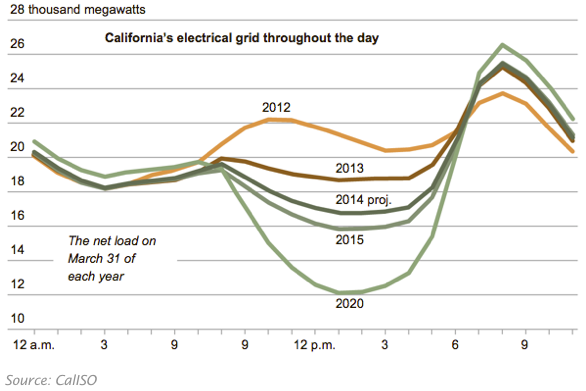
The grid as free battery is on the way out as the importance of "when" grows. I've been wrapped up on Patent issues and missed the "Duck Curve" as a concept. Let's look into that shall we?

here is a "distributed generators fight back" read on the duck curve:

Solar supporters: Open season utilities duck on Ilsr.org:

"The duck is the perfect vehicle for utility complaints because it casts the growth of distributed solar as a major technical problem (an area where most policy makers defer to utilities) rather than an economic one, where utility complaints can be contrasted with their customer’s desires for more local control over their energy use and costs."
That 5 to 8 ramp is something else! It is certainly a call for west facing PV arrays... And some short-term storage too. What might many solar pre-chilling of HVAC condensers do to that picture? Could a daytime version of the Ice Bear eat the Utilities Duck? The Ice Energy people are used to marketing to utilities (smart) but the other side is also serviceable if you have surplus generation that would be curtailed during the day - better to shunt it to ice and then pull out that service during the peak charge time of 5 to 8...
"Short term storage, meet solar thermal, solar thermal, meet short term storage.

Thursday, January 8, 2015

Breaking news... (wow did this sound familiar)

I got a Google Alert based on my "Solar PVT" find criteria. Usually it just gets me new solar companies that have PVT in their names... but today a jackpot instead.

A beam-splitting photovoltaic thermal receiver for solar concentrators

A photovoltaic thermal receiver that separates incoming light energy by wavelength can produce electricity and thermal output of 150° simultaneously.
 I know! Right? This is what I am talking about. Right down to the 150C heat... The full story.

Then some more digging (god bless the internet - nearly instant satisfaction on things like this)

http://www.sciencedirect.com/science/article/pii/S1876610214003348

Pretty neat stuff. But not a spork-killer I think... only 10 to 20 X concentration and so it has high silicon content and everything they have is at minimum 20 to 40 times as big and materially/coatings intensive as my design... I'm not sure how they see commercial viability. (I hope they do see it as we are all looking for the pay-no-pay line.)

It looks like they might be working with Chromasun. That would be interesting. 

I have to dive into that second paper tomorrow or Saturday as it has the meat... but I thought I'd share as soon as I saw it.

If you read it let me know what you make of it!

Saturday, December 6, 2014

Did we talk about the white Paper in 2011?

It occurs to me that you might not have found the white paper from back in 2011...

It is in a few places. Try this one.

Early on I was trying to figure out if there were any deep flaws I could discover in the high temperature hybrid approach. This paper lays out a defense of the thinking. It is pretty short and some of the data is a good bit less flattering than it could be (caution on my part mostly). Take a look though and let me know what you think. I need to write a new one with the improved optics and reduced cost of goods and maybe some more up to date economic evaluations too.

Not mentioned there but mentioned elsewhere in this blog are my observations about the unrealistic aspect of VC money expectations in a hardware/energy market. This is a really lean domain. Better to strap solar onto a roofing company, or just a lending operation. What winning money there has been in the Solar biz seems to have been there for the people who captured the finance part and some of the tool sellers. There have been winners but not VC style super block busters, or am I missing somebody?

I think about PVTsolar which became First solar and then got bought out by SunEdison, for cheap. At least that is what I gathered. Probably making OK gear and selling it for a reasonable markup etc but not the kind of huge win the VC types that backed the first iteration were looking for. I wonder if those kinds of wins were ever going to be possible in the energy market. I know they need some kind of motivating illusion to take the risk and we are talking about somewhat new markets so optimism is a good thing but while the gear is new the need (energy) is old and it is met by many competitors.

Got to get back to the grind.

Tuesday, November 25, 2014

Focused Sun... a low tech low concentration approach

Ugly - in a good way...

Focused Sun

They must have been in stealth mode as no pictures seem to be on the web save for the ones in the release, until Nov. 17th when they launched an Indigogo campaign. A million dollar goal and no early givers. Yikes. And the csp-world story neglected to mention the indigogo campaign.

https://www.indiegogo.com/projects/focused-sun

It is much smaller than I thought based on the csp-world picture. Pretty good coverage in the video of why it is affordable.  It does not look like it is weather hard to the degree that it should be. But I like the effort to make it low tech and "makeable." I'm in the let many flowers bloom camp: but this does not seem deeply considered.

Also interesting (as a side note) that it is a collaboration between a Swede and some Americans in New Mexico. One of my favorite rivals is also designed by a Swede (the Solarus.se effort). I guess I must elevate my herring intake to stay in the game!

Take a look and let me know what you think.

Tuesday, November 11, 2014

PowerPanel guys are still plugging away. I love the tank design. ALOT.

Check out the video at the bottom of their home page: hot water storage could not be easier I think. Up to 200 F and it can be walked through any doorway and fits 350 gallons. (that's 93 C and 1325 l)

It looks like there are really only two foam parts (wall and half top/bottom) and a liner and an external girdle. Just all kinds of clever. Wish they'd show a price for it.

http://www.powerpanel.com/

My design does not require storage. I just love smart. And this is smart stuff.


Irradiation evenness... getting better by a bunch

Thought I'd tease a bit of the recent findings from the optics team:

Earliest proof of concept:


takeaway... not good but the photons do get there... and I learned a lot.

Knowing where the trouble comes from (and rethinking many other tangentially important elements) gets us this:

these are not the same scale (btw) what we care about is the evenness of the light and of the image. The low value (or more precisely intensity) yellow smear is easily corrected (nearly a column above.) The cell size can now drop to about 1/5 the original intended size. I've not tiled it as a hexagon (an even better fit if you hope to grab circular images with fewer wasted margins. ) Hexagons should fit even better on parent wafers... quick estimate 500 per 156mm pseudo square... that is a tiny bit of Silicon serving a very large aperture.

I am trying to characterize the packing factor (how much margin is lost by the space between cells). Or in my case the space between individual mirror "wells." It is better for the heat (.95 or so) than for the PV but if those smears above get into the center they might scavenge  us up to 92 or so. Which would add aperture-efficiency to our list of accomplishments.

Stay tuned!

Study from the Thermal side of the house...

Thermal Plant .(com) is my new internet crush!

Here are some compelling figures on hybrid PVT systems from a thermal perspective. Optimization of the thermal fraction is their agenda and they pound TRNSYS to get some insight. Cool.

here is some of it:

The performance of the PVT system consists in the renewable energy production, net of auxiliary devices’ consumption. Expressed in terms of primary energy, this balance is in general considered an energy saving for the users. Obtained results are shown in the following figures.

Fig. 7. Total energy saving in case of electric heater and natural gas heater
Fig. 7. Total energy saving in case of electric heater and natural gas heater Fig. 7. Total energy saving in case of electric heater and natural gas heater

 By observing the graphs, it can be seen that primary energy savings are much more consistent in case of electric heater in comparison with natural gas one. Anyway, in both cases, by increasing the PVT collector surface the total energy saving is not increasing linearly, which leads to conclude that global system efficiency is slightly decreasing by increasing PVT area.
This  happens  because  the  largest  number  of  collectors  increases  the  heat  transfer  fluid  mean temperature in each loop, while progressively reducing both the PV and thermal efficiency.
However, to perform a complete assessment of the PVT energy performance, global system costs and
savings potentials must be taken in consideration, as reported hereafter.

Wednesday, October 29, 2014

IBM Sunflower (Welcome to the Thunder Dome II (part two)

IBM and Airlight team up to develop the Sunflower. HCPVT collector. (High Concentration Photovoltaic Thermal.)

Everything is better with a Swiss scientist to show you around, no?


I found this embedded here at Gizmag. A much better story than the others, thank goodness. The collector dish is more creative than the rest of their scheme, I think. They use a fibrous concrete for the dish. Vacuum shaped sheer sheets of metalized foils or the like for the compound primary (40 square meters!) There would need to be dynamic control of that vacuum as the atmospheric pressure changes you do not want a new focal length imposed as the weather and temperature changes....

This just in: a friend tracked down this EDN story. It is not too interested in the offboard bits (low temp implementations and balance of system stuff) but a nice juicy account of a voltage management scheme comes up late in the story, spoiler alert: something called a "Δ-converter" is important. As is putting this important voltage management gear pretty darn close to the cells. Or so it seems.

All of this is worrisome as these are the same cells that are sitting at a 2,000 suns focal point. I'm going to call this "putting all your eggs in one frying pan." Shows a whole lot of faith in the tracking and the cooling apparatus.

I also wonder which disconnections are requiring Flyback Diodes (freewheeling?) Dear readers, what do you see when you read that report. (The images on the EDN story seem to have been pulled. But the PDF still has them (download link here)

Japan rethinking distributed power

Like Hawaii before it, Japan is facing down "too much of a good thing" problem.

"Half of Japan's electric utilities move to restrict additional solar power"

 http://www.eenews.net/stories/1060006761

It will get worked out, but look for more of this kind of trouble before it settles down.

Cool tool to explore current energy use by buildings in the USofA


Take a look! they have about a million buildings (I wish it were not by state but by latitude) still lots and lots of cool data to play with.


www.buildingenergy.com

Tuesday, October 7, 2014

IBM - Welcome to the Thunder Dome II

I've been meaning to discuss and size up the IBM hybrid attempt. I saw their cell/module cooling device for large high concentration dishes awhile back. take a look:


Illustration from a Whitepaper on the IBM Sunflower (hybrid CPVT)

What do you see? you see water inlets and outlets for a mission critical back side cooling array. That is the left/bottom side plumbing bits. We cannot see the very smart way they put a high flow highly conductive network for flowing very close to the back of the cells (the 9 dark squares) For size you can see the thermocouple plugs (grey with two different sized and colored blades) they are about a half inch wide (just checked, .66 inches or 17 mm which means those cells are 10mm/10mm.


This needs to be really heat hardy as the cells are supposed to be exposed to some 2000 suns. The paper (or some-other source, they are starting to run-together, sorry) says they are backside conductor cells. Those black faces, unlined by traditional front-side conductors, are confirmation of that.

The two thermocouples are there to monitor the coolant temperature before and after to regulate the flow of coolant. This of course means they have the traditional tradeoff issues that I am trying to avoid with frequency splitting. If the temp goes up the voltage goes down and the electric yield drops. So they are stuck with a lot of very warm water as a product. The good news is they have a vision of this as a very large device and some ideas about what to do with the warm water. More on that in the next post.

I saw some confused notions about using this for boiling water for desalination. The description in that story is pretty vague and has a real units of measure problem. Maybe a deadline pressure meets domain knowledge weakness caused it. Anyhow, further looking shows they have a reverse osmosis scheme (in separate equipment) that uses pressure rather than brute force boiling (which is why reverse osmosis and the related technologies are being explored in general: less energy intensive.) The cooling circuit needs to be closed to keep the high purity and reliability going behind the cells.

We'll look at the collector's reflector array next time.

Wednesday, August 6, 2014

You get more of what you measure...

I had not noticed SolarThermalWorld until today. Looks like PVT is in a ghetto there too. Still some good coverage of PVT with a thermal emphasis. Fair enough. This story got my attention and maybe it should get yours.

Story here 

here is what jumped out for me:

  • So far, PVT collectors have not been included in the standard. But there is already a so-called extended scope, which means that they may be included later in a second part of the standard.
  • Fluid-based collectors will see some changes in their testing procedures compared to EN 12975-2. The new standard regards the collector gross area as the relevant reference for all area-specific data, e.g., the yield per area. Until now, the reference used in Germany has been the aperture area, which has presented some difficulties in comparing collector data on an international basis.

PVT with its interaction between the energy streams is going to be tough to pin down. My design has low interaction between the "sides" which is great for me but all of the hybrids are going to need to represent the various modes of operation and the variety of operating temperatures is vexing.


Tuesday, July 29, 2014

Hawaii - way out font. In a bad way.

Greentech media has a pretty good intro to the current state of things in the USA's most built out PV market: Hawaii.

story here

Among the things that stand out are

1) Many circuits on Oahu that are 120% of Daytime Minimum Load.  Too much of a good thing?
2) Discussion of the end of Net Metering. (duh!)


Thursday, May 29, 2014

Some more up to date comparisons...

I'm off to work on Rev 2 of the design but it seems appropriate to layout why it is worth the bother.

Here are some comparisons to two good examples to give context :

Kyocera 325W Polycrystalline Solar Panel KD325GX-LPB
and (the awesome)
SunPower SPR-X20-445-COM (445 watts!)

Fortunately they are both 2.19 square meters each so watts per square meter STC can be derived but a better gauge is PTC (avail here) which mostly accommodates the Temperature Coefficient in a more real world manner:

Kyocera's goes down to 290.4 for the panel and so 132.6 per square meter
Sunpower goes down to 412.7 for the panel and so 188.45 per square meter
vs
Hybrid V1 is 23 watts per tube and 128 per square meter

We could imagine those panels reformed as magic edge-less strips as long and wide as our tubes and get
23.9 watts per strip from the Kyocera
33.9 watts per strip from the Sunpower
vs
23.0 watts from our tube (setting aside the thermal for the moment) 

How to layout the hybrid value? Here is an attempt at a tote board, normalized to per square meter


Top scored cells BOLD

OR if you'd rather:
1 panel of 2.19 square meters (1.66m X 1.32 m = 2.19 m^2) ≈ 12 Hybrid Rev 1 tubes ( .18 m square each X 12 tubes  = 2.16m^2 of area)

More on Hybrid version 1:
The Hybrid collector's first design iteration was analyzed in part by BRO (http://www.bro.com/) This design revealed some shortcomings that I've attacked in the version two but the analysis of version 1 can serve as a "floor" for evaluation. The figures were good enough to keep going on... Some of the shortcomings of the rev one design and their easy resolution I'll cover later. But for now Rev 1 is the best understood as far as throughput. I think 20% of the losses in Version 1 can be clawed back but all of this post is about Version 1.

For a square meter of tubular collector 320 watts of visible light hit the PV cells in clear light. That light arrives on 10X10mm cells at 46,700 W/m^2 (46.7 Suns.) The 320 watts would hit 98 10mmX10mm concentrator cells in that design. and the cells should be able to operate at @66C or below. They could be expected to run at 40% (due to the rich diet and the high concentration/low temp.) that 320W*.40= 128w =12.8% efficient (started vs the 1000 Wm^2 total light) on the PV side in realistic atmospheric conditions. There are troubles with that 12.8% number but they cut both ways. The fraction of incident light captured in the heat components is about the same (340W) but the conversion is much more efficient ~80% at 160C output temp. So 340W*.80=272 or 27% on the thermal side for a net 39.8%

Some of the columns need explication:
Relative Performance on a Heat Load:
Cogenera (in a white paper) sees the _heat value_ as 25% of electric value in a Watt to Watt comparison when that heat is delivered at Domestic Hot Water Temps. Sounds fair. So 128+(272*.25)=196. I weighted them all at the Sunpower as 1 (the conversion losses in electric resistance heat being very low, these correspond to the Gross Efficiency number.)

Cooling Power in Watts:
Cogenra shows the way again in a paper "Cooling with Cogen" they find the value of high temp heat used in chilling service to be higher than plain old thermal DHW service due to the COP (coefficient of power) in double effect chillers. Thus we get the "Cooling power in Watts" comparison. In most cases I imagine those "Cooling Watts" would be Watts not used ("negawatts" generated at peak rates) and potentially freeing up watts from the electrical side to sell at those peak rates or to otherwise address demand charge problems. All subject to the particular installation conditions and metering contracts of course.